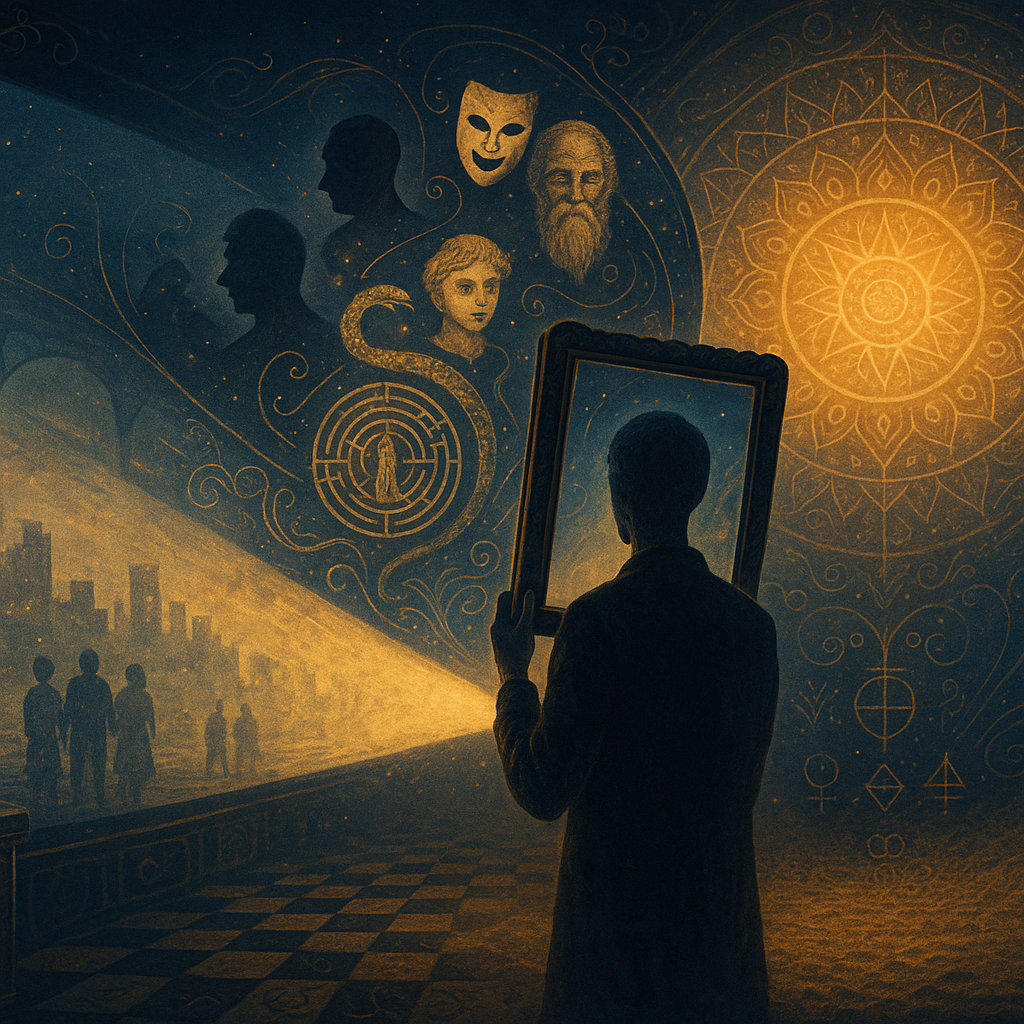
The Mirror of the Psyche: Jung's Discovery That Changed Everything
Carl Jung spent decades observing a peculiar pattern in human behavior, one that would eventually crystallize into perhaps the most transformative insight of depth psychology. Through thousands of clinical encounters and his own harrowing journey into the unconscious, he arrived at a conclusion that initially seemed impossible, yet explained everything: we have never experienced objective reality. Every moment of our existence has been filtered through the psyche, refracted through complexes, shadows, and unconscious patterns we didn't know we carried.
Jung realized that human beings live inside a psychological simulation of their own creation, mistaking it for external reality. The person who betrayed us reveals something about our relationship with trust. The opportunity we missed shows us something about our readiness. The pattern that keeps repeating represents the psyche's urgent attempt to make something conscious. We haven't been living life so much as living our psychology, and until we grasp this fundamental truth, we remain trapped in an endless loop, fighting shadows on the wall while believing them to be real monsters.
The Architecture of Projection
What Jung discovered wasn't merely interesting theory but the fundamental structure of human experience itself. He observed that the unconscious constantly projects itself onto the world, and every unintegrated part of the psyche gets externalized, appearing to come at us from outside. The shadow manifests as the people who trigger our most irrational reactions. The anima or animus appears as those we find magnetically attractive. Our complexes show up as recurring problems that seem to follow us regardless of circumstances.
Consider the person whose presence makes you inexplicably angry, not someone actually causing harm, but someone whose mere personality creates disproportionate irritation. Jung would say you're not seeing them at all. You're seeing your own rejected aspect, hating in them what you've disowned in yourself. Or think of someone you find yourself obsessing over, unable to stop thinking about them. That's not really them either. That's your own unlived potential, your inner feminine or masculine, projected onto them as though they were a movie screen displaying your unconscious content.
Jung validated this mechanism through careful clinical observation. The woman who repeatedly attracted narcissists was projecting her own disowned self-importance. The man who kept experiencing betrayal was projecting his own capacity for betrayal that he couldn't face. The person perpetually surrounded by chaos was projecting their own inner disorder. Once Jung helped them see the projection, the external circumstances either shifted or ceased to have the same emotional charge.
Fighting the Mirror
Here's where Jung's insight becomes profound in its implications. Once we recognize that everything is projection, we stop fighting the mirror. Imagine the absurdity of punching your reflection because you dislike what you see. Yet this is precisely what most people do throughout their entire lives, fighting with people who are simply showing them themselves, resisting situations that are revealing their psyche, running from experiences that represent the unconscious becoming conscious.
Jung worked with a patient who complained that everyone in her life was controlling. Every relationship, every job, every situation involved someone trying to control her. She spent years fighting these controlling people, leaving relationships, quitting jobs, even moving to different cities. Jung helped her see that the control wasn't out there at all. She was projecting her own disowned need for control. She was so terrified of her own controlling nature that she projected it onto everyone around her and then fought it externally.
The moment she recognized this pattern, everything shifted. Not because the world changed, but because she stopped fighting her own projection. She reclaimed the projection, owned her controlling nature, and suddenly the controlling people either vanished from her life or stopped seeming controlling. This represents Jung's first key insight: our life problems are projection problems. We're not struggling with reality but with our own unconscious material appearing as reality.
The Filmmaker Who Forgot
Jung discovered something that sounds like fiction but operates as psychological fact. The unconscious constantly creates our reality through projection, and then the ego experiences that reality as though it's happening to us. It's remarkably similar to being a filmmaker who creates a movie, develops amnesia, watches their own film, and believes it to be documentary footage of real events.
The mechanism works like this: the psyche carries certain patterns, complexes, and unfinished business. These create what Jung called archetypal situations, basic templates of human experience. The unconscious then keeps creating these situations in our lives until we recognize them as our own creation. The abandonment complex generates abandonment situations. The authority complex produces authority conflicts. The unworthiness complex manifests as experiences of rejection, not once but repeatedly, like a broken record playing until we finally hear the pattern.
Jung observed this with remarkable consistency. A man who complained about being unseen by others couldn't see that he was invisible to himself. A woman who felt constantly judged was running an internal court where she served as judge, jury, and defendant. A person who experienced life as meaningless had never genuinely asked what meaning meant to them. They were creating their reality from unconscious assumptions, then experiencing that reality as objective fact.
Psychic Reality and the Problem of Consciousness
Jung recognized that psychological reality is more real to us than physical reality. We don't live in the world but in our perception of the world, and that perception is created by unconscious projections. This explains why positive thinking so often fails. We cannot consciously think our way out of unconscious patterns. It's like trying to change a movie by yelling at the screen when the projection originates from somewhere much deeper than thought.
But when we realize we're the projectionist, when we see that we're creating what we're experiencing, everything changes. Not because we suddenly control everything, but because we finally understand what's actually happening. We stop asking why this is happening to me and start asking what part of my psyche is creating this. We stop being the victim of our movie and become curious about why we're screening this particular film.
Jung lived this way himself. When something difficult occurred, he wouldn't merely react. He would ask what his unconscious was showing him through the situation. When someone triggered him, he would wonder what part of himself that person represented. He treated his entire life as communication from his unconscious to his conscious mind, and he discovered that's exactly what it was.
The Single Problem Behind All Problems
Jung's most radical insight was that there's really only one problem in human life: unconscious material running our lives from the shadows. Every other problem represents a symptom of this singular issue. Depression is unconscious grief or anger turned inward. Anxiety is unconscious material trying to become conscious. Addiction is unconscious needs seeking fulfillment through unconscious means. Relationship problems are unconscious projections dancing with other unconscious projections. It's all the same problem wearing different masks.
Jung treated a patient who went through five marriages, all ending the same way. She believed she had terrible luck with men. Jung showed her she had one unconscious pattern playing out five times. She wasn't meeting five different men but meeting her own unconscious pattern five times, dressed in different bodies. Once she saw the pattern, once she made it conscious, she didn't need a sixth marriage to learn the lesson. The pattern was complete, the unconscious material had become conscious.
This is why Jung famously said, "Until you make the unconscious conscious, it will direct your life and you will call it fate." Every fate is simply an unconscious pattern. Every instance of bad luck is unconscious repetition. Every resigned acceptance that "this is just how life is" represents unconscious acceptance of an unconscious pattern.
Consciousness as Universal Solvent
The liberating truth Jung discovered is this: since all problems are really one problem, there's only one solution. Consciousness. Not positive consciousness or enlightened consciousness, just plain consciousness, seeing what is actually happening versus what appears to be happening. When we see that we're creating our abandonment experiences, the pattern loses power. When we recognize we're projecting our shadow onto others, the projection returns to us. When we realize we're living out an unconscious complex, the complex begins to dissolve.
Jung discovered this personally during his confrontation with the unconscious, documented in what would become The Red Book. He was flooded with disturbing visions, overwhelming emotions, and psychological chaos. His ego wanted to fight it, fix it, make it stop. But then he realized the chaos wasn't the problem. His unconsciousness about the chaos was the problem. When he stopped fighting and started observing, when he brought consciousness to the unconscious material, the chaos transformed into insight. The visions that seemed like madness became the foundation of his psychology. The emotions that felt destructive became creative energy. The chaos that appeared meaningless revealed profound meaning. Nothing changed except his consciousness about what was happening, and that changed everything.
The Wisdom Already Within
Jung discovered something remarkable about learning and insight. Every breakthrough doesn't come from new information but from suddenly seeing what was always there. The answer doesn't arrive but is revealed. We don't learn something new but remember something forgotten. This occurs because everything we need to know already exists in our unconscious, waiting to become conscious.
Jung proved this with his technique of active imagination, having patients dialogue with their unconscious. Profound wisdom would emerge, wisdom the patients didn't know they possessed. The wise old man who offered guidance was their own inner wisdom projected as a figure. The divine child who brought renewal was their own creative potential personified. The shadow who revealed uncomfortable truth was their own rejected knowing. It was all them conversing with themselves through the medium of projection.
We don't need more information but more consciousness about the information we already have. We don't need more answers but to see the answers hiding in our questions. Every seeking is actually avoiding. Every search outside is fleeing from inside. Jung understood that the seeking ends when we realize everything we've been looking for is what's doing the looking.
The Self Beyond Projection
Jung discovered that behind all projections, beneath all patterns, beyond all complexes, there exists something that doesn't project: the Self. Not the ego-self we identify with, but the Self that witnesses all identifications. This Self doesn't have problems because it doesn't identify with problems. It doesn't have patterns because it observes patterns. It doesn't project because it recognizes projections.
We've been identifying with our projections, thinking we are our personality, our problems, our patterns. But we're not. We're what's aware of all that. It's as though we've been watching a movie and thinking we're a character in it, when actually we're not in the movie at all. We're watching the movie. We're not our life but what's experiencing our life.
Jung called this the Self with a capital S, and he said individuation is the process of shifting identification from ego to Self, from the character to the witness, from the projection to what's beyond projection. This isn't spiritual bypassing but psychological fact. Right now, you're aware of reading these words, aware of thoughts arising, aware of feelings moving through you. That awareness is closer to what you actually are than any content of awareness.
When we recognize ourselves as awareness rather than content, every problem shifts. We're not depressed but aware of depression moving through us. We're not anxious but aware of anxiety arising. We're not our trauma but aware of trauma patterns playing out. This isn't denial but a fundamental shift in identity, and from this shifted position, we have options we didn't have when we thought we were the problem.
Living the Recognition
Jung's method for living this understanding was simple but radical: treat everything as communication from the unconscious. When someone triggers us, ask what part of ourselves this person is showing us. When a pattern repeats, wonder what the unconscious is trying to make conscious through this repetition. When a problem persists, investigate what unconscious material is creating it.
The crucial element is not doing this from the ego position of trying to fix things but from the Self-position of curious observation. We're not trying to stop projecting, which is impossible. We're trying to recognize projection as projection while it's happening. We're not trying to eliminate patterns but to see them clearly.
Jung called this holding the tension of opposites. We simultaneously live our life and observe ourselves living it. We're in the movie and watching the movie. We participate and witness. This takes practice because the ego wants either to collapse into identification (I am this problem) or escape into spiritual bypassing (I'm above all problems). But individuation happens in the tension between these positions.
We learn to say "I'm experiencing depression" rather than "I'm depressed." "Anxiety is moving through me" rather than "I'm anxious." "A pattern is playing out" rather than "This always happens to me." These small linguistic shifts represent massive psychological shifts, changing our relationship with our experience.
The Ultimate Recognition
Jung's ultimate message, the thing that makes everything else secondary, is this: our entire life is our unconscious becoming conscious. Every person, every situation, every moment is the psyche trying to know itself through projection and recognition. We're not here to win at life but to wake up to life. We're not here to solve all problems but to recognize problems as projections. We're not here to become someone better but to realize who we've always been.
This isn't philosophy or belief system. It's what's actually happening whether we see it or not. The unconscious is constantly projecting. Life is constantly reflecting. The only question is whether we're conscious of the process.
Jung's entire psychology leads to one recognition: it's all us. It's always been us. The moment we truly see this, the seeking ends and the finding begins. Not because we suddenly possess all answers, but because we discover where all answers come from. They come from us. They always have.